“Art game” is one of those phrases people use confidently and define vaguely. It gets thrown at anything pretty, anything sad, anything short. So let’s actually pin it down, because there’s a real thing underneath the fuzzy label.
An art game is a game made primarily to express an idea, feeling, or aesthetic statement, rather than to entertain through challenge or reward. The design serves meaning first. Fun, difficulty, and progression — the usual engines of a game — are optional, and sometimes deliberately withheld. If a normal game asks “is this satisfying to play?”, an art game asks “does this say something, and does the act of playing it carry the saying?”
The term got real traction in the late 2000s, largely around a handful of small, pointed works.
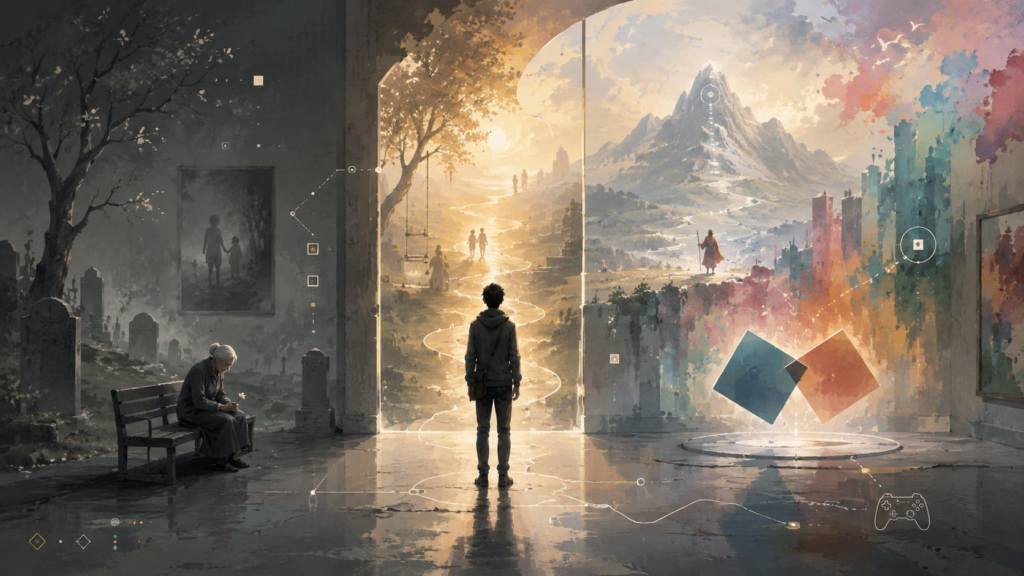
Passage (Jason Rohrer, 2007) is the cornerstone. Five minutes, a corridor of pixels, aging, a companion, death. It’s a game about mortality where the mechanics — you literally cannot see the far end of your life, and a companion both limits and enriches your path — are the argument. Rohrer even wrote an artist’s statement to accompany it, which tells you how the thing was meant to be received.
The Graveyard (Tale of Tales, 2008) lets you guide an old woman as she walks to a bench in a cemetery, sits, and listens to a song. That’s it. In the free version, nothing else happens. It’s barely a “game” by conventional standards — which is exactly the point being made.
The Marriage (Rod Humble, 2007) represents a marriage as two abstract squares that grow and shrink based on attention and outside pressures. There’s no winning. It’s a diagram of a feeling.
From there the sensibility spread into more accessible work. Dear Esther (The Chinese Room) turned an art-game sensibility into a form people could actually sink into — a wordless-adjacent walk that made “walking simulator” a genre. Journey (thatgamecompany) brought the art-game spirit to a mainstream, award-winning stage: no dialogue, no fail state to speak of, an emotional arc delivered almost entirely through movement and anonymous human connection. Gris (Nomada Studio) wrapped a story about grief in hand-painted watercolor, using the return of color itself as its central mechanic and metaphor.
You’ll notice a family resemblance: short, often wordless, more concerned with a single feeling than with systems, and frequently about loss, time, or connection. That’s not a coincidence — those are the themes that survive being stripped down to pure mechanics.
There’s an old, tired argument lurking here — “are games even art?” — and I’ll sidestep it, because the games above already answered it by simply being art, regardless of what anyone calls the category. The more useful question isn’t whether games can be art. It’s what games can do that other art can’t: make you perform the meaning instead of just receiving it. Passage doesn’t tell you about mortality; it makes you live a compressed life and end it. That’s the art-game promise.
And it’s why this whole site is named after one. The End of Us — a two-minute, wordless game about loss — is an art game in the purest sense: no points, no win, no words, just a feeling you have to move through yourself. If the games above sound like your kind of thing, that’s the neighborhood we live in.