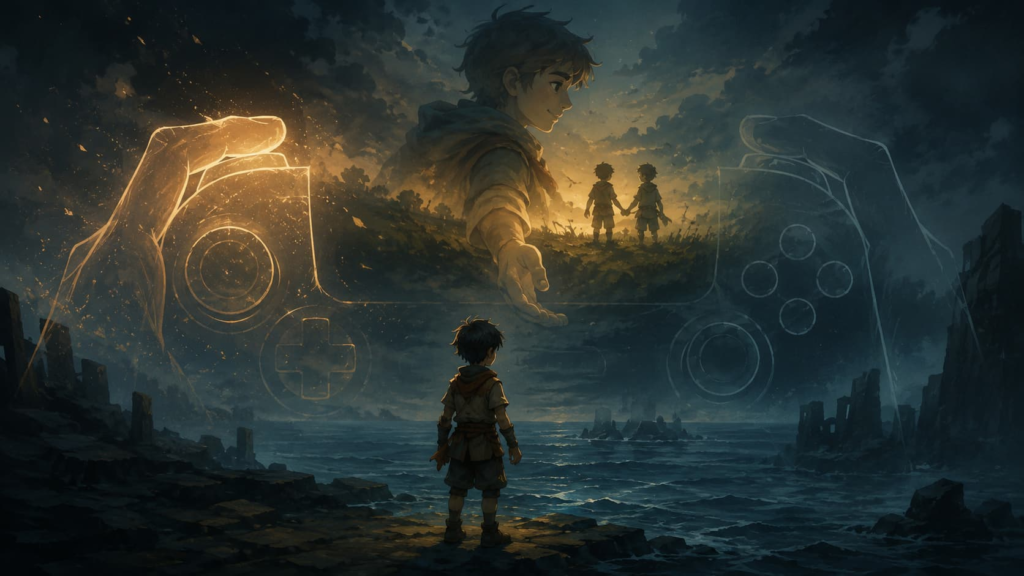
Most games make you cry with cutscenes — the music swells, a character says the thing, you feel the thing. That’s fine. But it’s the game handing you an emotion the way a film does. The rarer, stranger power is when a rule — a piece of the mechanics themselves — makes you feel something. When the way you press the buttons becomes the meaning.
The best example I know is Brothers: A Tale of Two Sons.
The setup is simple. You control two brothers at once: the older brother on the left stick and left trigger, the younger on the right stick and right trigger. From the first minute, this feels a little awkward — two characters, two hands, one brain trying to coordinate them. But you learn it. It becomes second nature. You stop thinking “left is the big brother, right is the little one” and just move them, together, the way you’d stop thinking about your own two feet.
Early on, the game establishes a quiet fact: the younger brother is afraid of water. He nearly drowned once, and their mother did drown. Whenever the brothers cross deep water, the older one has to carry the younger on his back. The little brother can’t swim. The game teaches you this not with a speech but with the controls — you simply cannot make him swim alone.
Then, near the end, the older brother dies. And you keep playing, now controlling only the younger one, your left hand suddenly, pointedly idle. The absence is physical. Half your muscle memory has nothing to do.
The gut-punch comes later, at a stretch of deep water the younger brother has to cross — the exact thing the game spent hours telling you he cannot do alone. There’s no one to carry him now. And to make him swim, the game asks you to press the left trigger. The dead brother’s button. The one your left hand hasn’t touched since he died.
You press it, and the younger brother finds the strength to swim — drawing, the game is saying without a single word, on everything his brother gave him.
I have never cried at a quick-time event. I cried at a button. Because the meaning wasn’t in a cutscene I watched — it was in a motion my own hand had to perform, a motion that meant one thing for the whole game and suddenly meant something devastating. The mechanic carried the grief. That’s the thing only games can do, and almost none of them try.
Story can make you cry. Any medium can do that. But when the rules of a game make you cry — when pressing a button is the emotion — you’re seeing the form do something no other art can. Brothers is the clearest proof I’ve got that it’s possible.