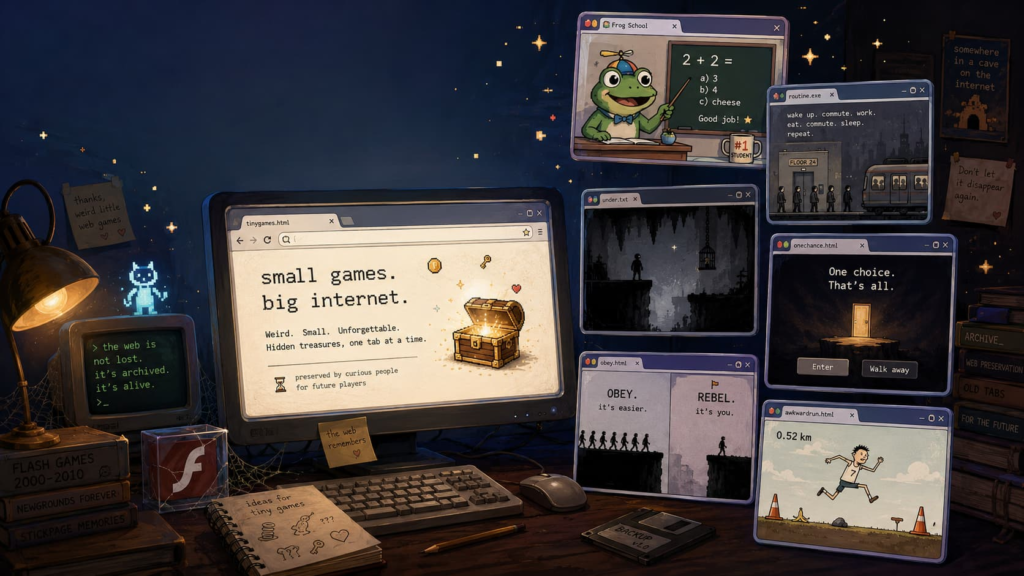
Somewhere along the way, “browser game” became shorthand for something cheap, disposable, and buried under ads. That reputation misses what made browser games special in the first place: they were immediate. No launcher, no enormous download, and no setup. You clicked a link and started playing.
The browser-game era covered everything from enormous online worlds like RuneScape to tiny experimental games built around one strange idea. The smallest games rarely had marketing budgets or polished campaigns behind them. What they had was a concept strong enough to carry the entire experience.
Frog Fractions, by Twinbeard, begins as an unremarkable educational game about a frog solving math problems. Then it changes. Explaining how would ruin the joke, because discovering what the game really is remains the entire point. Go in knowing as little as possible.
Every Day the Same Dream, by Molleindustria, turns the repetition of work and routine into a short, grey nightmare. You wake up, get dressed, commute, enter the elevator, and return to the same office. The game gradually reveals small opportunities to resist that routine. It lasts around ten minutes but leaves behind a much larger feeling.
Don’t Look Back, by Terry Cavanagh, retells the myth of Orpheus and Eurydice as a stripped-down platformer. It is difficult, brief, and unexpectedly painful. Cavanagh later created games such as VVVVVV and Super Hexagon, but many of the ideas that define his work are already visible here.
One Chance is built around a rule most games would never dare enforce: you only get one playthrough. The game remembers your decisions and refuses to let you restart. That single restriction turns a simple story into something more uncomfortable. Your choices cannot be cleaned up with another save file. You have to live with them.
A Dark Room, by Doublespeak Games, begins with little more than a few lines of text and a button labeled “light fire.” From that nearly empty opening, it slowly expands into something much larger. Revealing what it becomes would weaken one of the best surprises in browser-game history.
Loved, by Alexander Ocias, is a stark platformer about authority, obedience, and control. A narrator gives you instructions, insults you, and reacts when you refuse to cooperate. The game’s meaning comes from the simple choice between obeying those commands and doing the opposite.
Then there is QWOP, Bennett Foddy’s masterpiece of intentional frustration. You independently control a runner’s thighs and calves and are asked to complete a 100-meter race. Most attempts end with the athlete collapsing after a few awkward steps. The joke is not simply that the controls are difficult. It is that the game turns something as natural as running into an impossible act of coordination.
Finding many older browser games is harder than it used to be. Adobe ended support for Flash in 2020, leaving thousands of games and animations inaccessible through normal browsers. Preservation projects have kept much of that history alive. Flashpoint archives a huge collection of older web games, while the Ruffle emulator allows many Flash projects to run again through modern technology.
New browser games are still being made as well. Many now appear on itch.io, where developers can publish small projects that run directly on the page. The technology has changed, but the appeal remains the same: one person, one idea, and almost no barrier between you and the experience.
Browser games never truly disappeared. They moved to new platforms, new tools, and new communities.
The End of Us, the short wordless game that gave this site its name, came from that same tradition. It was free, brief, immediately playable, and quietly devastating. There are still countless games like it waiting to be found. You simply have to know where to look.