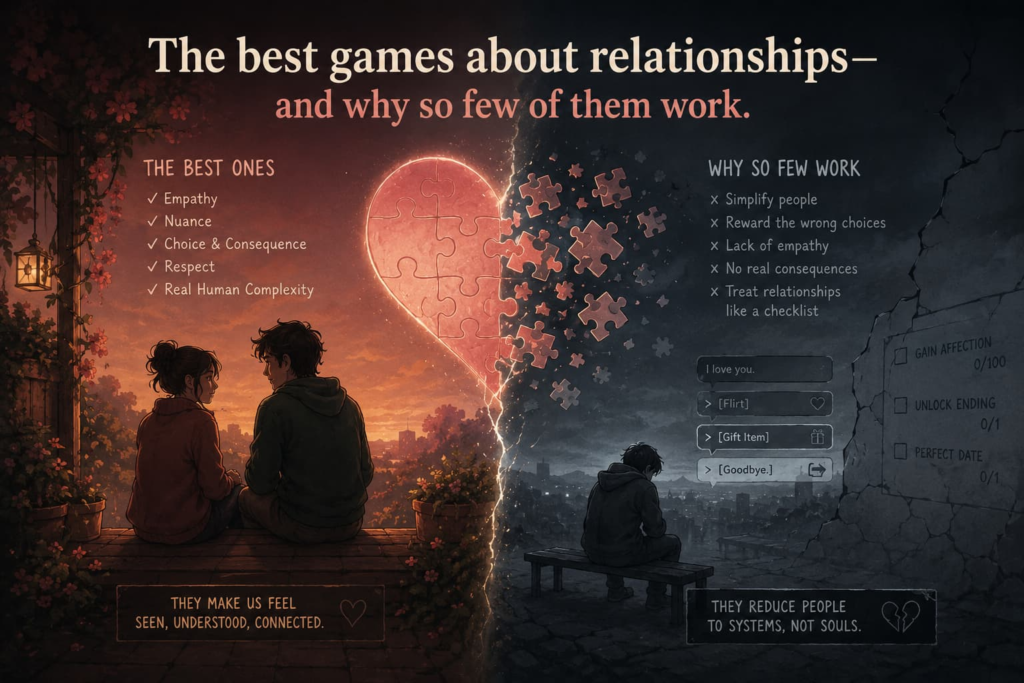
There’s a specific silence a good game about a relationship leaves you in. Not the silence after a hard-won boss fight. The other kind — where you set the controller down and don’t reach for your phone, because something landed.
Games are strangely bad at love. This is odd, because they’re wonderful at almost everything else emotional: dread, triumph, loneliness, the small clean joy of a well-timed jump. But romance and friendship? Most games treat connection like a vending machine. Feed it enough gifts and correct dialogue choices, receive affection in return. A relationship as a crafting recipe.
The games that get it right refuse that model. They understand something the vending-machine games don’t: a relationship isn’t a reward you unlock, it’s a thing you’re inside of, that acts on you whether you optimize it or not.
Here are the ones that understand.
Florence is the clearest example anyone’s made. It’s a short mobile game — 45 minutes, no dialogue — about a 25-year-old named Florence and a cellist named Krish. It tells the whole arc of a first serious relationship through tiny interactions: early conversations are jigsaw puzzles with many pieces, fiddly and slow, the way talking to someone new is work. As the two get comfortable, the puzzles need fewer pieces — talking gets easy. During an argument, the pieces multiply again. The mechanic itself is the relationship. It’s the best single design idea about love that games have produced.
It Takes Two takes the opposite scale — a big, loud co-op adventure — and uses it to tell a story about a couple on the edge of divorce, forced to cooperate to survive. The genius is that the game literally cannot be played alone. Two people, two controllers, every obstacle requiring you to actually rely on the person next to you. The theme isn’t in the cutscenes; it’s in the fact that you can’t proceed without trusting each other.
Firewatch is a relationship built entirely out of voices on a radio. You’re a fire lookout in the Wyoming wilderness; your only human contact is your supervisor, Delilah, on the other end of a handset. You never see her. The whole thing — warmth, flirtation, disappointment — is carried by two people talking across distance, and it earns every beat.
Gone Home and Night in the Woods widen the lens past romance. Gone Home is a story about a sister you piece together from the empty rooms of a house. Night in the Woods is about the friendships you return to when you drop out of college and move home, and how they’ve changed while you were gone. Both understand that the relationships that shape us most aren’t always the romantic ones.
And The End of Us — the game this site is named after — belongs here even though it has no “relationship” in any literal sense. It’s two objects moving through space, and then not moving through space together. No dialogue tree, no affection meter. Just a before and an after, rendered so simply you can’t argue with it.
So why is this genre so thin? My theory: a game mechanic is a machine for producing a feeling reliably. Jumping reliably produces mastery. Combat reliably produces tension. But love isn’t reliable — it’s specific, contradictory, and it resists being turned into a repeatable input-output loop. The moment you systematize it, you kill the thing you were depicting. The games that succeed mostly cheat: they make the relationship short (Florence), or wordless (The End of Us), or they refuse to let you optimize it. They shrink the scope until honesty becomes possible.
The sprawling RPG romance fails not because the writers are bad, but because the form — a gameable system with an optimal strategy — is at war with the content. The second a relationship has a best strategy, it stops being a relationship and becomes a lock you’re picking.
What I want is more games brave enough to make connection un-winnable. The ones that already exist prove it can be done. There just aren’t enough of them yet.